


[ad_1]
Within the quickly evolving realm of software program improvement, microservices have emerged as a game-changer, revolutionizing the way in which trendy purposes are constructed, deployed, and scaled. Microservices structure, with its emphasis on modularity, scalability, and resilience, has grow to be the go-to strategy for organizations striving to fulfill the calls for of right this moment’s dynamic and fast-paced digital panorama.
On the coronary heart of each profitable microservices structure lies the necessity for seamless integration between numerous companies, enabling them to speak, collaborate, and coexist harmoniously. On this quest for integration excellence, one platform stands out as the final word alternative: Node.js. With its light-weight, asynchronous, and versatile nature, Node.js has cemented its place as the popular platform for integrating microservices. On this article, we’ll discover why Node.js is the right match for microservices integration and delve into finest practices for harnessing its energy to construct scalable and resilient microservices architectures.
Understanding Node.js: The Powerhouse of Asynchronous Programming
Node.js, an open-source, cross-platform JavaScript runtime constructed on Chrome’s V8 JavaScript engine, has gained immense recognition not too long ago, significantly for its means to deal with asynchronous I/O operations effectively. In contrast to conventional server-side applied sciences, Node.js makes use of a non-blocking, event-driven structure that enables it to deal with a number of concurrent connections with out the overhead of thread-based concurrency fashions. This makes it preferrred for constructing extremely responsive and scalable microservices architectures the place asynchronous communication is prevalent.
Asynchronous Nature: Unlocking Concurrent Efficiency
On the earth of microservices, the place companies talk with one another over networks and carry out I/O-bound operations equivalent to making HTTP requests, querying databases, or processing messages from queues, asynchronous programming is paramount. Node.js’s event-driven, non-blocking structure makes it exceptionally well-suited for dealing with asynchronous operations, permitting microservices to speak seamlessly with out blocking the execution thread. This permits microservices architectures to attain excessive ranges of concurrency and responsiveness, important for assembly the calls for of contemporary, distributed purposes.
Light-weight and Scalable: Empowering Microservices Orchestration
One of many key benefits of Node.js is its light-weight and scalable nature, making it an excellent platform for orchestrating microservices in distributed environments. With its small reminiscence footprint and environment friendly useful resource utilization, Node.js permits builders to deploy and handle microservices with ease, whether or not it’s by means of containerization applied sciences like Docker or orchestration platforms like Kubernetes. This inherent scalability makes Node.js an ideal match for constructing and scaling microservices architectures to fulfill the evolving wants of contemporary purposes.
Wealthy Ecosystem: Abundance of Instruments and Libraries
Node.js boasts a thriving ecosystem of NPM (Node Package deal Supervisor) modules, offering an unlimited array of libraries and frameworks for constructing and integrating microservices. Whether or not it’s dealing with HTTP requests with Categorical.js, implementing messaging patterns with RabbitMQ or Kafka, or orchestrating microservices with instruments like PM2 or Kubernetes, Node.js gives a plethora of instruments and libraries to streamline the event and integration of microservices. This wealthy ecosystem accelerates improvement cycles, enhances productiveness, and empowers builders to construct sturdy and scalable microservices architectures with ease.
You might also learn: 10 Essential Node.js Packages for Trendy Growth Wants
JSON All over the place: Seamless Information Interchange
On the earth of microservices, the place companies talk with one another utilizing light-weight information interchange codecs equivalent to JSON (JavaScript Object Notation), Node.js’s native help for JSON simplifies the method of serializing and deserializing information between microservices. Since Node.js is constructed on JavaScript, which natively helps JSON, it eliminates the necessity for extra serialization/deserialization libraries, making communication between microservices seamless and environment friendly. This native help for JSON accelerates improvement cycles and enhances interoperability, facilitating easy communication between microservices in a distributed structure.
Greatest Practices for Node.js Microservices Integration
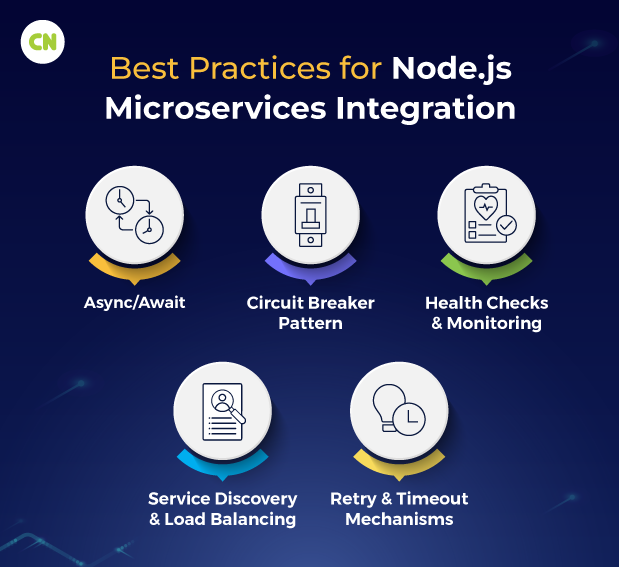
Whereas Node.js supplies a robust platform for integrating microservices, adhering to finest practices is important for constructing sturdy and scalable microservices architectures. Listed here are some finest practices for leveraging Node.js to combine microservices successfully:
- Use Async/Await for Asynchronous Operations: Embrace Node.js’s async/await syntax to write down clear, readable, and environment friendly asynchronous code, making it simpler to deal with asynchronous operations equivalent to community requests and database queries.
- Implement Circuit Breaker Sample: Implement the circuit breaker sample utilizing libraries like ‘opossum’ or ‘brakes’ to deal with failures and stop cascading failures in microservices communication, guaranteeing resilience and fault tolerance.
- Implement Well being Checks and Monitoring: Implement well being checks and monitoring endpoints in every microservice to make sure service availability and detect points proactively. Instruments like Prometheus and Grafana can be utilized for monitoring Node.js purposes, enabling real-time insights into the well being and efficiency of microservices architectures.
- Implement Service Discovery and Load Balancing: Make the most of service discovery mechanisms like Consul, etcd, or Kubernetes service discovery to allow dynamic service registration and discovery, guaranteeing seamless communication between microservices. Implement load balancing utilizing instruments like Nginx or HAProxy to distribute incoming visitors evenly throughout a number of cases of microservices, optimizing efficiency and scalability.
- Implement Retry and Timeout Mechanisms: Implement retry and timeout mechanisms in microservices communication to deal with transient failures gracefully and stop long-running requests from blocking the system, guaranteeing reliability and responsiveness in microservices architectures.
You might also learn: Why Select Node.js for Enterprise Utility Growth?
Conclusion
In conclusion, Node.js stands out as the final word platform for integrating microservices, due to its asynchronous nature, light-weight and scalable structure, a wealthy ecosystem of instruments and libraries, and seamless help for JSON information interchange. By leveraging Node.js together with finest practices for microservices integration, builders can construct scalable, resilient, and environment friendly
microservices architectures that energy trendy purposes in right this moment’s fast-paced digital world. Whether or not you’re constructing a small-scale utility or a large-scale distributed system, Node.js empowers you to unlock the complete potential of microservices and drive innovation on the planet of software program improvement. So, embrace Node.js, unleash its energy, and embark on a journey to construct the following technology of microservices architectures that redefine the way in which we construct, deploy, and scale purposes within the digital age.
Able to take your digital options to the following degree with Node.js microservices? Our knowledgeable Node.js builders are right here to assist. By selecting to rent a Node.js developer from our staff, you’re not simply getting a coder; you’re gaining a associate devoted to enhancing your digital panorama. Let’s innovate collectively and construct sturdy, scalable microservices that may set your purposes aside. Attain out right this moment and begin reworking your concepts into actuality with the ability of Node.js.
[ad_2]

